
Up to 99.8% Efficiency

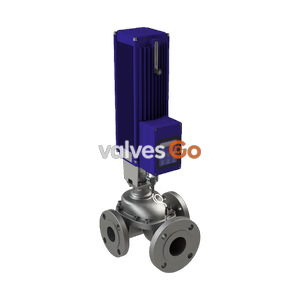
BURKERT Type 2301 pneumatically operated 2-way globe control valve. Features a flow-optimized stainless steel body, high cycle life, and integrated automation.
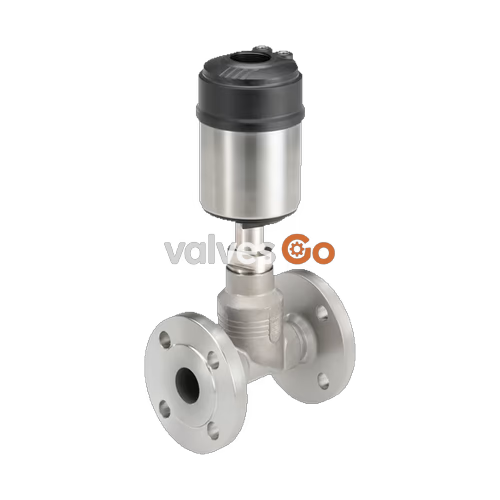
BURKERT Type 2301 is a pneumatically operated 2-way globe control valve designed to fulfill tough criteria for process environments. Unrivalled cycle life and sealing integrity are guaranteed by the proven self-adjusting spindle packing with exchangeable V-seals. The fully integrated system has a compact and smooth design, integrated pneumatic lines, IP65/67 protection class, and superior chemical resistance.
Each globe valve body can be fitted with up to five sizes of trim sets. These parabolic trims provide a reliable and repeatable characteristic to vary the flow. The control cones are available in either stainless steel or with a durable PTFE seal or PEEK seal for tight shut-off, achieving leakage class III, IV, or VI. The design enables the easy integration of automation modules, whether they are digital electropneumatic positioners or process controllers.

Key Features
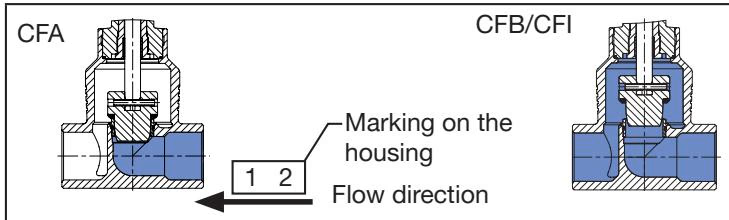
The valve seat is always closed against the medium flow. Spring force (CF A) or pneumatic pilot pressure (CF B and CF I) generate the closing force on the control cone. Because the medium pressure is below the control cone, it helps open the valve.
| Symbol | Description |
|---|---|
| CF A | Pneumatically operated 2/2-way control valve. Flow direction below seat. Normally closed by spring force. |
| CF B | Pneumatically operated 2/2-way control valve. Flow direction below seat. Normally opened by spring force. |
| CF I | Actuating function via reciprocal pressurisation. |
| Property | Value |
|---|---|
| Design | Globe control valve |
| Nominal diameter | DN 10...DN 100, NPS 3/8...NPS 4 |
| Flow direction | Flow to open (below seat) |
| Operating pressure | 0...25 bar(g), 40 bar(g) on request |
| Nominal pressure | PN 25/PN 40 (DIN EN 1333), Class 150 (DIN EN 1759) |
| Seat leakage | Leakage class III and IV for stainless steel; Class VI for PTFE and PEEK |
| Operating characteristic | Equal percentage, linear (others on request) |
| Medium temperature | -40 °C...+230 °C |
| Ambient temperature | -10 °C...+80 °C (depending on control unit) |
| No. | Element | Material |
|---|---|---|
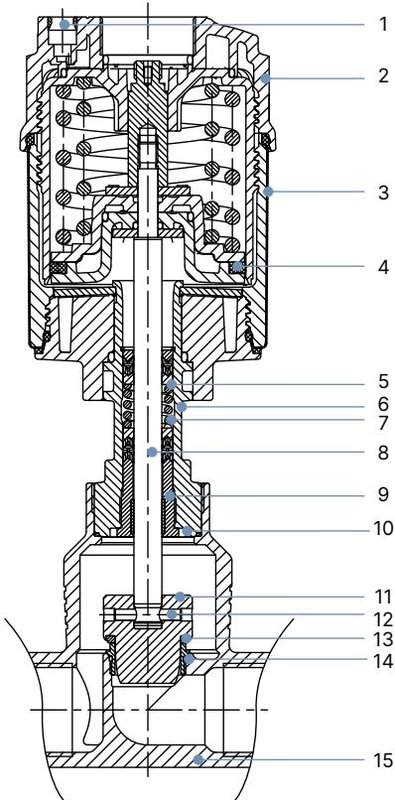
| 1 | Pilot air ports | Push-in connector PP |
| 2 | Actuator cover | PPS |
| 3 | Actuator casing | Stainless steel 1.4561 (316Ti) |
| 4 | Piston seal | FKM |
| 7 | Packing gland | PTFE V-Rings (filled), with spring compensation |
| 8 | Spindle | Stainless steel 1.4401 (316)/1.4404 (316L) |
| 11 | Control cone | Stainless steel 1.4571 (optionally hardened) |
| 13 | Seat seal | Stainless steel 1.4571, PTFE or PEEK |
| 15 | Valve body | Stainless steel 316L / CF3M |
Safety Instructions
Explore similar products in our catalog