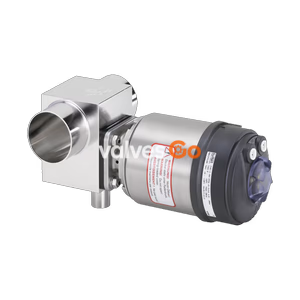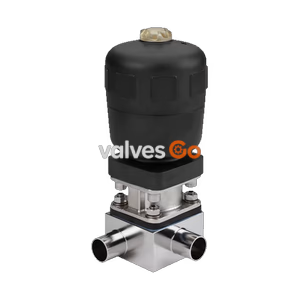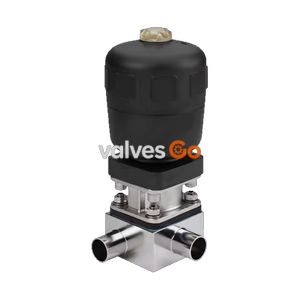
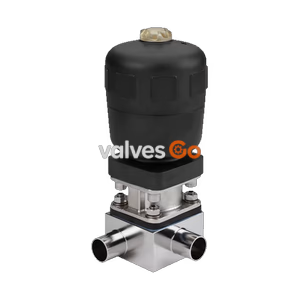
Type 2032

Burkert 558627 Type 2031 is a 2/2-way piston-operated diaphragm valve with PPS actuator, stainless steel body, welded BS 4825 1/2" ports, normally closed operation, and PTFE/EPDM diaphragm for sterile media.
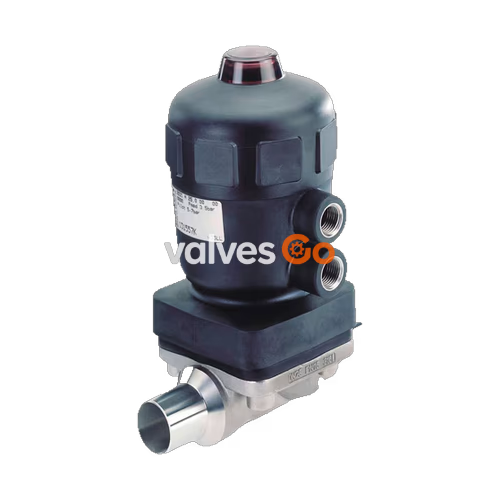
BURKERT 558627 (Type 2031) is an externally controlled 2/2-way diaphragm valve designed for shut-off control of neutral, ultrapure, sterile, and chemically aggressive liquid or gaseous media. As part of the CLASSIC series, it combines a compact, autoclavable polyphenylene sulphide (PPS) pneumatic piston actuator with a forged stainless steel valve body (1.4435 / 316L). The valve is configured with Control Function A (normally closed by spring force), a nominal diameter of 8 mm (diaphragm size 8), and welded port connections conforming to the BS 4825 standard for 1/2" tubing (12.7 mm outer diameter, 1.2 mm wall thickness). Sealing is provided by a two-piece PTFE diaphragm backed by an EPDM cushion, achieving bubble-tight shut-off across an operating pressure span of 0.00 bar to 10.00 bar.
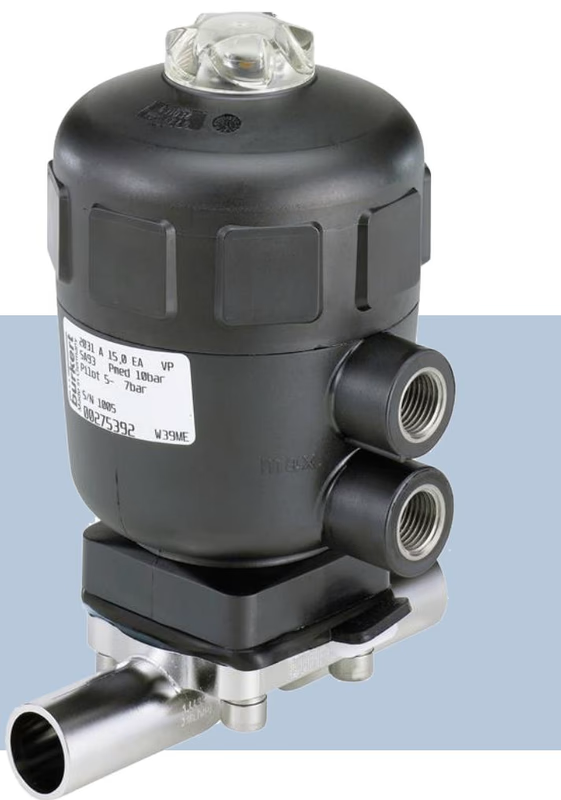
Burkert 558627 is engineered to meet sterile process requirements, offering full Clean-in-Place (CIP) and Steam-in-Place (SIP) capability. The fluidic channel features a flow-optimised weir design that minimizes internal dead volume, delivering a flow rate coefficient (Kv) of 1.5 m³/h measured with water at +20 °C.
| Technical Attribute | Specification Value |
|---|---|
| Product Identification | Article 558627 / Type 2031 |
| Valve Design | 2/2-way weir-type diaphragm valve |
| Operating Mode / Control Function | Control Function A (normally closed, NC) |
| Fluidic Port Standard | BS 4825 welded spigot connection |
| Port Nominal Size | DN 15 (tube OD 12.7 mm / 1/2", ID 10.3 mm) |
| Tube Wall Thickness | 1.2 mm (0.047") |
| Orifice Size (Nominal Diameter) | 8 mm (diaphragm size 8) |
| Flow Rate Coefficient (Kv) | 1.5 m³/h (water at +20 °C) |
| Operating Pressure Range | 0.00 bar to 10.00 bar (gauge pressure) |
| Pilot Pressure Range | 5.0 bar to 7.0 bar |
| Pilot Air Connection | G 1/8" internal thread |
| Medium Temperature Range | -10 °C to +130 °C (steam sterilisation up to +140 °C for 60 min) |
| Permissible Ambient Temperature | +5 °C to +140 °C (PPS actuator size ≤ 80 mm) |
| Pressure Rating | PN 16 (DIN EN 1333) / Class 150 (DIN EN 1759) |
| Installation Altitude | Up to 2,000 m above sea level |
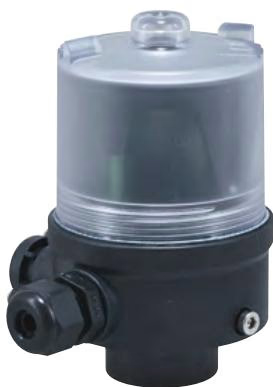
Actuator size 40 (C) is constructed from chemically resistant, autoclavable polyphenylene sulphide (PPS) as standard. An optical position indicator located inside a transparent polysulfone (PSU) cap provides direct visual feedback of the open/closed valve status.
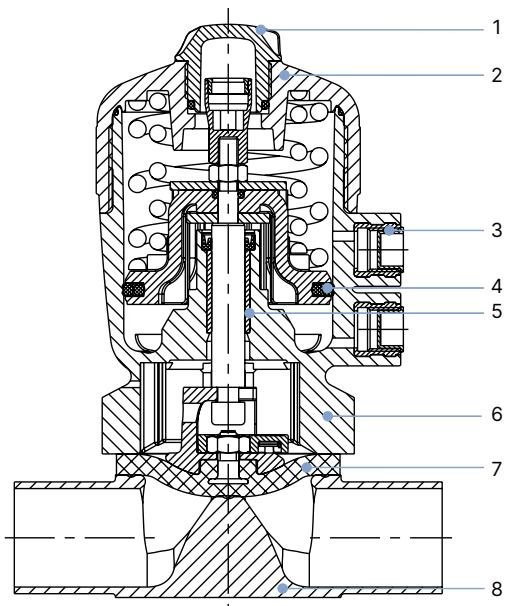
| Item No. | Element | Material |
|---|---|---|
| 1 | Transparent cap | Polysulfone (PSU) |
| 2 | Actuator cover | Polyphenylene sulphide (PPS) |
| 3 | Pilot air ports | Stainless steel 1.4305 |
| 4 | Piston seal | FKM (fluororubber) |
| 5 | Socket | Sinter metal |
| 6 | Interface | Polyphenylene sulphide (PPS) |
| 7 | Diaphragm | PTFE with EPDM backing diaphragm (EA) |
| 8 | Valve body | Forged stainless steel 1.4435 / 316L (BN2 / ASME BPE) |
Burkert 558627 operates under Control Function A (normally closed, CF A). In the rest position, mechanical compression springs positioned inside the PPS actuator push the piston down. The connected valve spindle transmits this closing force directly to the compressor, which presses the PTFE/EPDM diaphragm against the weir of the stainless steel valve body, ensuring tight shut-off against medium pressures up to 10 bar.
When pilot air at 5.0 bar to 7.0 bar is introduced into the lower pilot air port (G 1/8"), the pneumatic force overcomes the spring pack, lifting the piston, spindle, and diaphragm away from the weir to open the fluid passage. Releasing pilot pressure vents the lower chamber and allows the compression springs to immediately return the diaphragm to its closed position.
Burkert 558627 features welded spigots conforming to BS 4825. Actuator dimensions correspond to size 40 (C) with a pilot air port located at the lower cylinder base.
| Parameter | Dimension / Value |
|---|---|
| Diaphragm Size | 8 |
| Nominal Diameter (DN) | 15 mm (1/2" BS 4825) |
| Pipe Outer Diameter (∅ D1) | 12.7 mm |
| Pipe Wall Thickness (s) | 1.20 mm |
| Body Face-to-Face Length (L) | 89 mm (cast VG) / 108 mm (forged VS) |
| Port Centreline Height (h) | 9.6 mm (VG) / 8.15 mm (VS) |
| Body Height Under Flange (H) | 18.6 mm (VG) / 19.85 mm (VS) |
| Actuator Outer Diameter (∅ A) | 53 mm |
| Actuator Air Port Offset (C) | 34 mm |
| Pilot Air Connection Thread (K) | G 1/8" |
| Actuator Height (H) | 89 mm (standard CLASSIC size 40) |
| Overall Height with Type 8697 (HM) | 185 mm |
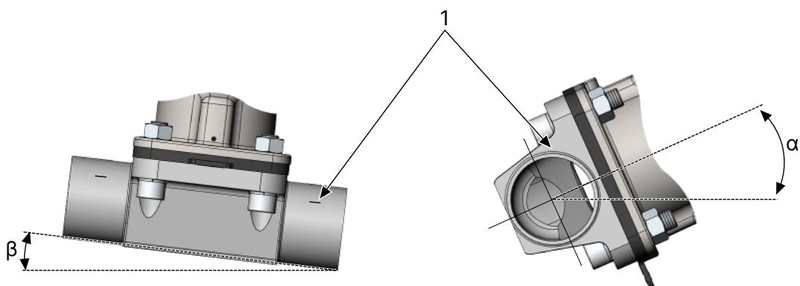
Burkert 558627 can be installed in any orientation, though upright positioning with the actuator facing vertically upward is recommended. To monitor potential seal degradation, one of the leakage relief bores in the diaphragm bonnet must be oriented at the lowest physical point.
Dismount Actuator Before Welding
Thermal conduction during orbital or manual welding will destroy the PTFE/EPDM diaphragm and internal actuator seals. The actuator and diaphragm must be completely unbolted and removed from the valve body prior to welding the body into the pipeline.
For complete drainage of liquid media without residue, the valve body must be installed at a specific angle relative to the pipeline axis:
For diaphragm size 8 with PTFE, advanced PTFE, or GYLON® diaphragm materials, the final tightening torque for the body screws is 2.5 Nm (+10% tolerance).
Burkert 558627 carries official explosion protection certifications for hazardous areas under ATEX and IECEx standards:
Media-wetted diaphragm materials comply with regulatory hygiene frameworks:
Under normal operating conditions with clean control air, the PPS pneumatic actuator is completely maintenance-free. Wearing parts (diaphragms and internal actuator seals) must be inspected at defined intervals:
Service Part Numbers
20093068 (Material code PTFE L11).011465 (contains piston seal, lip seal, and O-rings).639175 (diameter 40/50 mm).Burkert 558627 can be retrofitted with decentralized automation heads and position indicators designed for the CLASSIC series.
Explore similar products in our catalog