
Up to 99.8% Efficiency

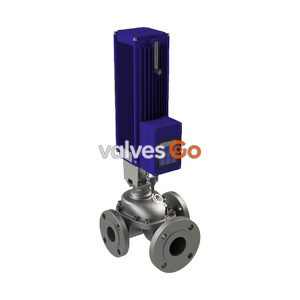
Burkert Type 3280 electromotive 2-way globe proportional valve features a non-wetted actuator, excellent setting range, and fast reaction time. Available in standard, positioner, and process controller variants up to 22 bar.
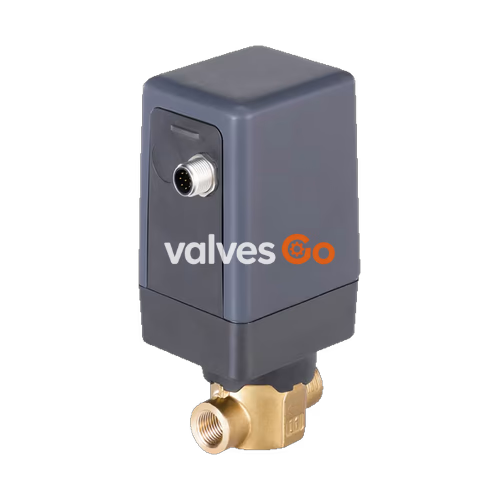
The Burkert Type 3280 is a direct-acting electromotive 2-way globe proportional valve suitable for dosing liquids and gases in closed or open control loops. The valve is driven by a linear stepper motor. The integrated electronics assembly simplifies process integration, eliminating the need for additional actuation modules. The motor requires no energy to maintain a specific valve opening, which can dramatically reduce the energy consumption of a plant and improve efficiency. Type 3280 is available as a standard on/off or proportional valve, as well as variants with an integrated positioner or process controller.
| Property | Description |
|---|---|
| Seal | NBR for liquids EPDM for liquids and special gases (e.g., ammonia, acetylene) FKM for neutral gases |
| Valve body | Brass, stainless steel |
| Orifice | DN 8...DN 15, NPS 1/4, 3/8, 1/2 |
| Flow direction | Against closing direction (below seat) |
| Design | Globe on/off valve, Globe control valve |
| Weight | ~0.7 kg |
| Operating pressure | 0...6 bar(g) High pressure variant up to 22 bar(g) optionally available Vacuum variant up to -0.9 bar(g) optionally available |
| Duty cycle | Up to 100% (depending on medium and ambient temperature) |
| Operating voltage | 24 V DC ± 10% (max. residual ripple 10%) |
| Power consumption | <1 W in holding position Max. 8 W (DN 2...DN 6) resp. max. 12 W (DN 8 and DN 10, as well as high-pressure variants) |
| Medium temperature | EPDM: -30 °C...+70 °C FKM, NBR: 0 °C...+70 °C |
| Viscosity | Max. 600 mm²/s (cSt) |
| Degree of protection | IP54 |
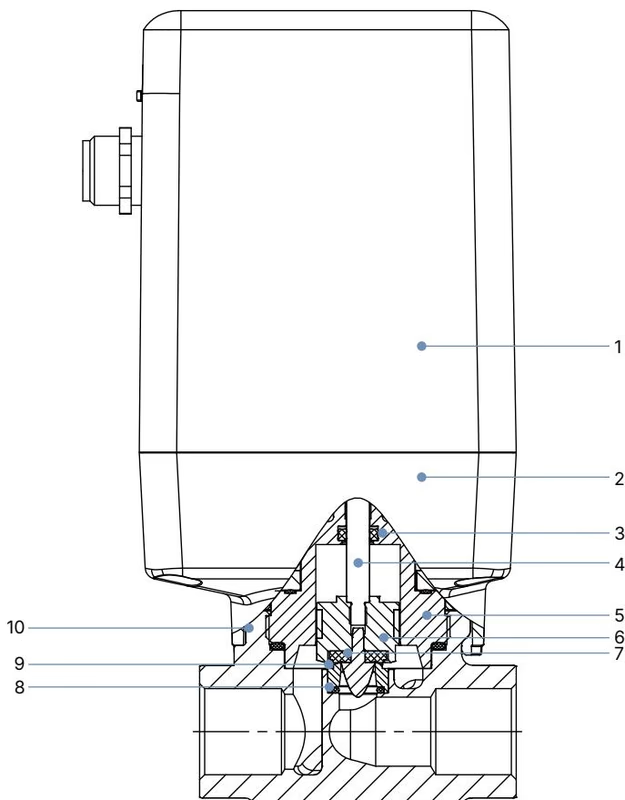
| No. | Element | Material |
|---|---|---|
| 1 | Housing cover | PC (Polycarbonate) |
| 2 | Housing base | PPS (Polyphenylenesulfide) |
| 3 | Spindle seal | FKM/EPDM/NBR |
| 4 | Spindle | Stainless steel 1.4305 |
| 5 | Upper valve body | Brass or stainless steel 1.4305 |
| 6 | Piston with parabolic control element | PTFE / Stainless steel 1.4305 |
| 7 | Elastomer seat seal | FKM/EPDM/NBR |
| 8 | O-ring | FKM/EPDM/NBR |
| 9 | Seat | Stainless steel 1.4301/1.4305 |
| 10 | Valve body | Brass or stainless steel AISI 316L |
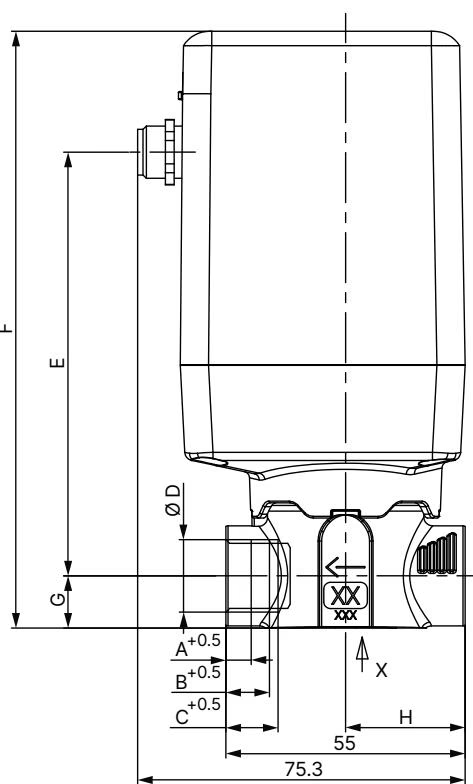
| A | B | C | D | E | F | G | H |
|---|---|---|---|---|---|---|---|
| - | - | 12 | G 3/8 | 97.4 | 137.2 | 12 | 27.5 |
| 6 | 10.3 | - | NPT 3/8 | 97.4 | 137.2 | 12 | 27.5 |
| - | - | 12 | G 1/4 | 96.4 | 134.2 | 10 | 27.5 |
| 5.8 | 10 | - | NPT 1/4 | 96.4 | 134.2 | 10 | 27.5 |
| - | - | 14 | G 1/2 | 97.4 | 139.2 | 14 | 29.5 |
| 8.2 | 13.7 | - | NPT 1/2 | 97.4 | 139.2 | 14 | 29.5 |
WARNING
Operating the valve outside the recommended duty cycle limits will result in a significantly reduced service life of the valve.
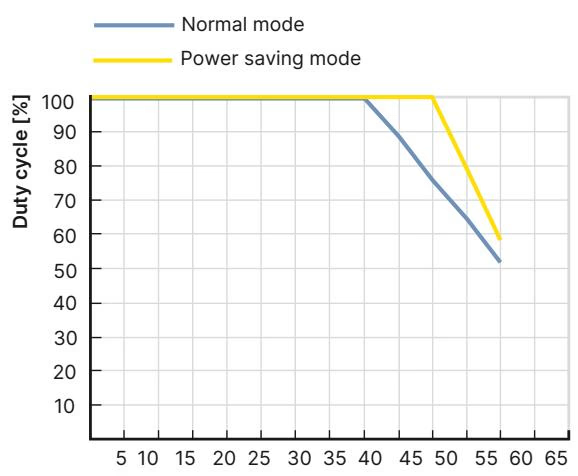
The duty cycle is an important factor for motor valves. The self-heating of the engine limits the maximum duty cycle. High ambient temperatures additionally increase the risk of damage due to overheating. The following diagram shows the recommended maximum duty cycle as a function of the ambient temperature.
| Valve function | Seat size | Port connection | Kvs-value [m³/h] | Pressure range [bar(g)] |
|---|---|---|---|---|
| Control valve, without safety position in case of power failure | 1 | G 1/4 | 0.030 | 0...6 |
| 1.5 | G 1/4 | 0.065 | 0...6 | |
| 2 | G 1/4 | 0.130 | 0...6 | |
| 3 | G 1/4 | 0.300 | 0...6 | |
| 4 | G 3/8 | 0.500 | 0...6 | |
| 5 | G 3/8 | 0.750 | 0...6 | |
| 6 | G 3/8 | 0.900 | 0...6 | |
| 8 | G 1/2 | 1.500 | 0...6 | |
| 10 | G 1/2 | 1.900 | 0...6 |
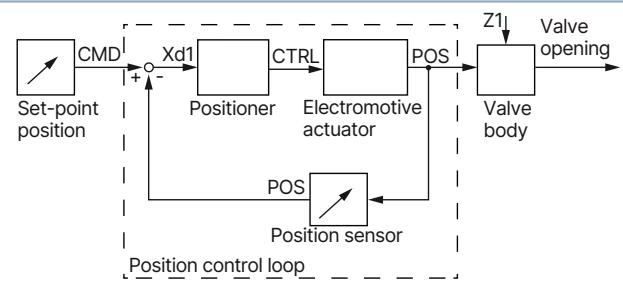
The proportional valve in the position control variant converts an external standard signal, the position set-point value, into a valve position. The position of the actuator is controlled according to the set-point position. The position sensor records the current position (POS) of the electromotive valve. This actual position is compared by the positioner with the set-point value (CMD) specified as the standard signal. If there is a control difference (Xd1), a motor control signal is given to the actuator as the actuating variable.
The additionally implemented PID controller can perform not only the actual position control but also a process control in the sense of a cascade control. The position setpoint of the valve is calculated from the process setpoint and the actual process value via the control parameters (PID controller). The process setpoint can be specified by an external signal.
DANGER
Risk of injury from high pressure in the system or device. Before working on the system or device, cut off the pressure and deaerate/drain lines.
Risk of injury due to electrical shock. Before working on the system or device, switch off and isolate the power supply to prevent reactivation of the device. Observe applicable accident prevention and safety regulations for electrical equipment.
Explore similar products in our catalog