PN16

BURKERT 20061110 (Type 8647 AirLINE SP) is an 8-slot electropneumatic valve island for Siemens SIMATIC ET 200SP with AirLINE Quick aluminium adapter, G 1/4 ports, D6 push-in, 2.5-10 bar pressure, and P-channel HotSwap.
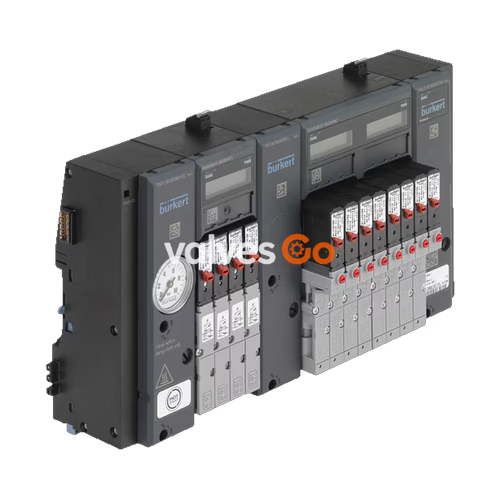
BURKERT 20061110 (Type 8647 AirLINE SP) is a modular electropneumatic automation valve island configured with an 8-valve slot pneumatic base, an AirLINE Quick anodised aluminium floor adapter, and native integration for Siemens SIMATIC ET 200SP distributed I/O systems. Engineered with an 11 mm width per station, this Generation Revision 2 assembly provides mixed 3/2-way valve functionality, pneumatic HotSwap on supply port 1 (P), and integrated check valves in exhaust lines 3 (R) and 5 (S) to prevent backpressure faults during operation.
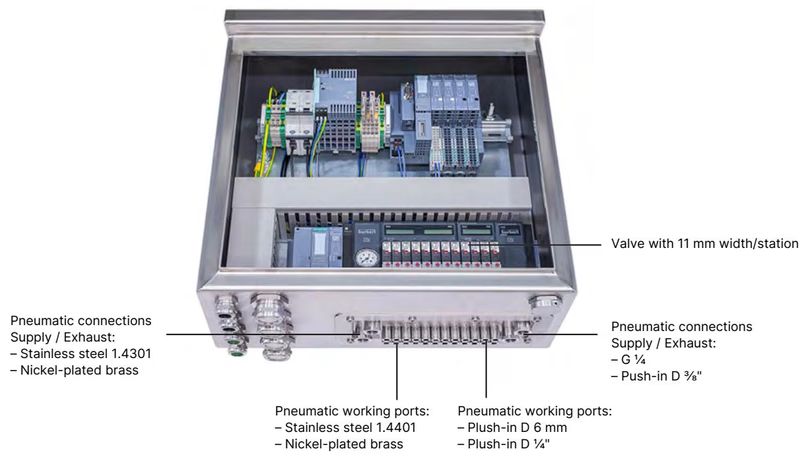
All working connections are routed directly through the control cabinet base via brass D6 push-in connectors, eliminating bulkhead feedthroughs and external tubing bundles inside the cabinet enclosure. The pneumatic block accommodates monostable and double pilot valves, operating over a pressure range from 2.5 bar to 10.0 bar at medium temperatures between 0 °C and +50 °C.
| Parameter | Specification |
|---|---|
| Article Number (SKU) | 20061110 |
| Valve Island Type | 8647 AirLINE SP |
| Hardware Generation | Revision 2 (REV.2) |
| Width per Station | 11 mm |
| Number of Valve Slots | 8 stations |
| Valve Configuration | Mixed valve population (3/2-way function) |
| Operating Pressure Range | 2.5 bar to 10.0 bar (gauge) |
| Medium Temperature | 0 °C to +50 °C |
| Ambient Temperature | 0 °C to +55 °C |
| Operating Medium | Lubricated or oil-free dry compressed air, neutral gases (ISO 8573-1:2010 Class 7.4.4, 5 μm filter recommended) |
| Supply Port 1 (P) | G 1/4 (Brass) |
| Exhaust Ports 3 (R), 5 (S) | G 1/4 (Brass) |
| Working Ports 2 (A), 4 (B) | Push-in connector D6 mm (Brass), bottom position |
| AirLINE Quick Material | Anodised aluminium |
| Body / Seal Materials | PA, PC (Valves: PA, PPS, FKM, NBR, PUR) |
| Operating Voltage | 24 V DC (±10%, residual ripple 2.4 Vss) |
| Nominal Power per Single Valve | 0.8 W (continuous operation 100% ED) |
| Flow Rate QNn (Air) | 300 l/min (at +20 °C, 6 bar inlet, 1 bar pressure drop; reduced by approx. 20% with integrated HotSwap) |
| Degree of Protection | IP20 (IP65 in closed cabinet; UL Type 4X with AirLINE Quick) |
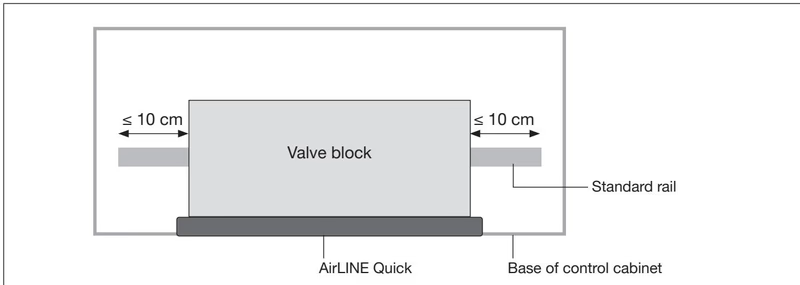
AirLINE Quick allows direct mechanical coupling of Type 8647 to the cabinet cutout floor or wall, using an anodised aluminium adapter plate fitted with brass pneumatic connectors. This configuration significantly reduces space requirements inside the cabinet enclosure, permitting smaller panel sizes while decreasing assembly time.
Mechanical Support Role
When installed with AirLINE Quick, the solid metal adapter plate acts as the structural foundation on the cabinet floor, supporting the standard rail and the attached Siemens SIMATIC ET 200SP modules, rather than hanging solely from the rail.
Cabinet Cutout Preparation
The cabinet floor cutout must be burr-free to prevent damage to the seal seated within the AirLINE Quick plate groove. Fix the external stability plate using M5x10 screws tightened to a torque of 2.0 Nm.
Article 20061110 incorporates Revision 2 hardware updates. REV.2 devices feature blue hose release rings on push-in connectors and a wavy channel arrangement for the working ports, replacing the straight parallel configuration of REV.1.
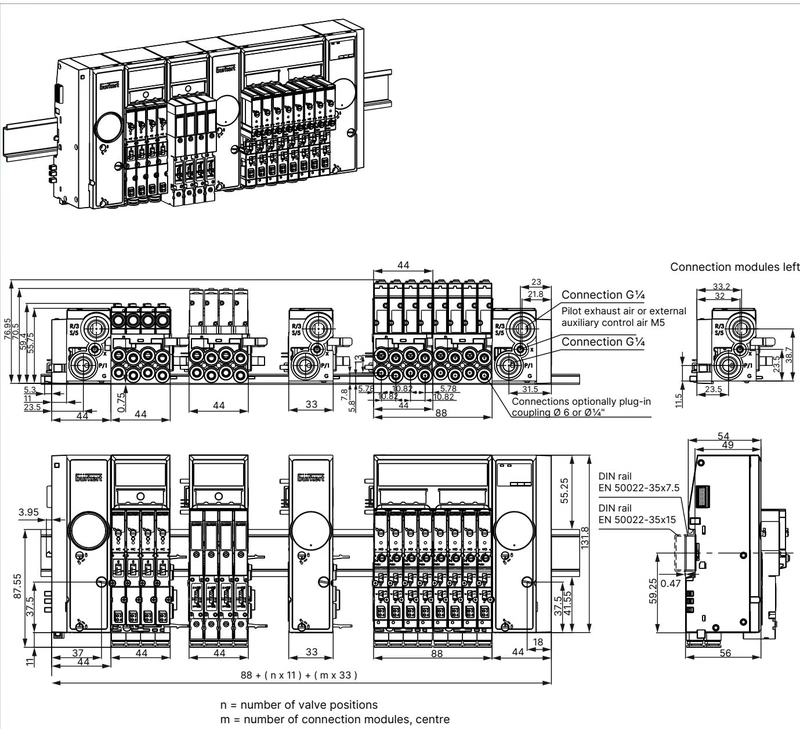
The pneumatic base module incorporates integrated P-channel check shut-off valves. This feature enables replacement of individual pilot valves during active operation without dropping system pressure from the central supply manifold.
Exhaust channels 3 and 5 are equipped with integrated check valves. These non-return elements suppress transient backpressures and prevent exhaust pulses from back-feeding into adjacent pneumatic actuators during simultaneous venting.
Type 8647 utilizes Type 6524 and Type 6525 pilot valves comprising a Type 6144 flipper solenoid and a pneumatic seat valve amplifier. In REV.2, the pneumatic flange pattern between the valve and the base module is standardized to the FM20 interface profile for single 3/2-way, single 5/2-way, and double 2x3/2-way valves.
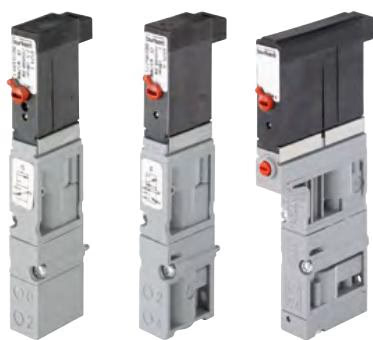
Single Valve Interchangeability
Single pilot valves from REV.1 (FM14 flange) and REV.2 (FM20 flange) are mechanically incompatible. Single valves on article 20061110 must only be replaced with REV.2-compatible FM20 spare valves.
Exclusion of Type 0460 Valves on AirLINE Quick
Due to physical dimensions, slide valves of Type 0460 cannot be installed on AirLINE Quick adapter bases.
| Valve Function | Orifice | Pressure Range | Voltage | REV.2 Article No. |
|---|---|---|---|---|
| 3/2-way NC (Circuit Function C), with manual override | 4.0 mm | 2.5 to 10 bar | 24 V DC | 20029918 |
| 3/2-way NO (Circuit Function D), with manual override | 4.0 mm | 2.5 to 10 bar | 24 V DC | 20029919 |
| 5/2-way (Circuit Function H), with manual override | 4.0 mm | 2.5 to 10 bar | 24 V DC | 20029920 |
| 2x 3/2-way NC (Circuit Function C), with manual override | 4.0 mm | 2.5 to 10 bar | 24 V DC | 204710 |
| Cover plate for unused valve slots (REV.2) | — | — | — | 661092 |
Article 20061110 communicates directly over the Siemens ET 200SP backplane bus, contacting power and data rails automatically when latched onto the standard rail. Configuration can be completed using GSDML in PROFINET IO or via Hardware Support Packages (HSP0225 for TIA Portal, HSP2105 for STEP 7 Classic, HUP for PCS7).
| Connection Port | Size | Function | Recommended Torque | Max. Torque |
|---|---|---|---|---|
| Port 1 (P), Ports 3/5 (R/S) | G 1/4 | Supply and exhaust air | 4.0 to 7.0 Nm | 20.0 Nm |
| Port X | M5 | Auxiliary pilot air / pilot exhaust | 1.0 to 1.2 Nm | 3.0 Nm |
| Push-in Connectors | M7 | AirLINE Quick working port fitting | 1.75 to 2.25 Nm | 4.0 Nm |
| Valve Screws | M2 | Pilot valve retention | 0.25 to 0.30 Nm | — |
| Baseplate Screws | M5x10 | AirLINE Quick stability plate | 2.0 Nm | — |
Tubing Preparation per ISO 14743:2020
Pneumatic tubing must be cut squarely with a sharp tube cutter. Angled cuts reduce retention force inside the push-in claw mechanism and compromise seal integrity.
| Outer Diameter (OD) | Tolerance (PA) | Tolerance (PU) | Min. Tensile Force (PA) | Min. Tensile Force (PU) |
|---|---|---|---|---|
| 6 mm (D6) | ±0.08 mm | ±0.10 mm | 120 N | 100 N |
| 1/4" | ±0.08 mm | ±0.10 mm | 120 N | 100 N |
Explore similar products in our catalog