Type 2032

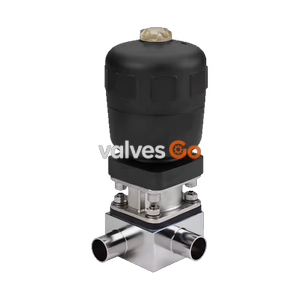
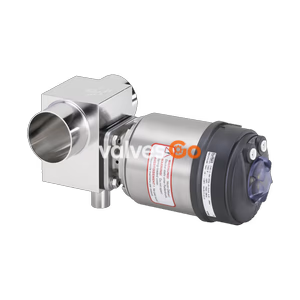
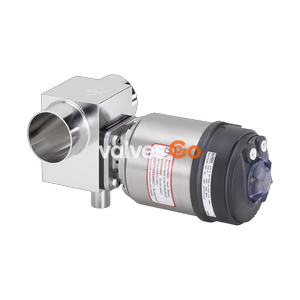
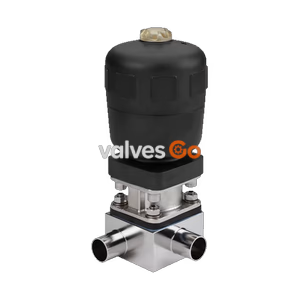
Burkert Type 2103 2/2-way diaphragm valve (SKU 321032) with pneumatic stainless steel actuator. Ideal for hygienic applications, featuring high flow rates, gap-free seals, and ATEX/IECEx options.
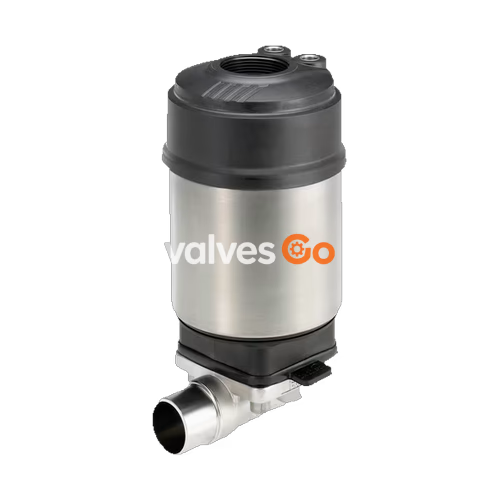
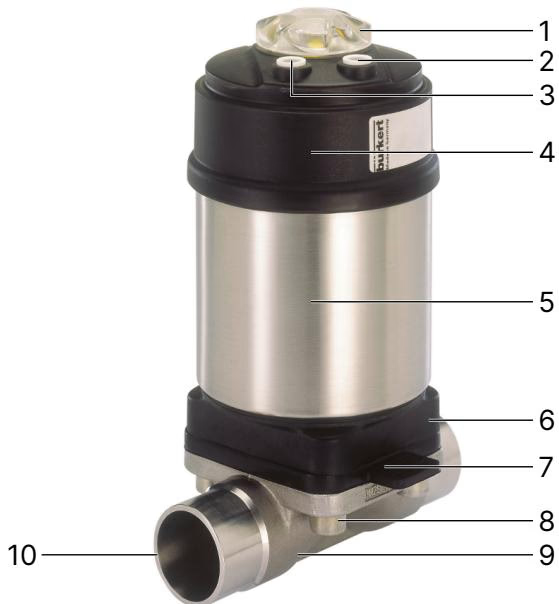
Burkert Type 2103 (SKU 321032) is an externally controlled 2/2-way diaphragm valve consisting of a pneumatically operated piston actuator, a diaphragm, and a 2-way valve body. The proven and robust actuator with a stainless steel housing ensures use in hygienic or aggressive ambient conditions. The flow-efficient valve bodies with little dead space enable high flow rates and a wide range of possible uses. The actuator has a compact, autoclavable design with a large stainless steel housing and gap-free seals. The integration of automation units Type ELEMENT is possible in all configuration levels; a fieldbus interface can also be integrated. An explosion-proof ATEX/IECEx device variant is available.
It is a compact, smooth-surfaced and highly integrated system consisting of a valve and an automation unit with integrated pilot air ducts (no intake of ambient air). The valve offers the degrees of protection IP65/67 and NEMA Type 4X and displays high chemical resistance.
| Diaphragm material | Medium temperature [°C] | Comments |
|---|---|---|
| EPDM (AD) | -10...+143 | Steam sterilisation max. +150°C for 60 min |
| FKM (FF) | 0...+130 | No steam, dry heat max +150°C for 60 min |
| PTFE (EA) | -10...+130 | Steam sterilisation max. +140°C for 60 min |
| Advanced PTFE (EU) | -5...+143 | Steam sterilisation max. +150°C for 60 min |
| GYLON® (ER) | -5...+130 | Steam sterilisation max. +140°C for 60 min |
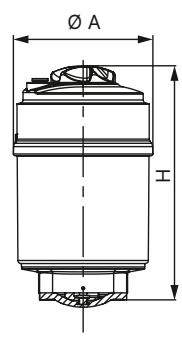
| Diaphragm size | Actuator size ∅ | ∅ A | H | HS with 8691/8695 | HS with 8690/8697 | H+M |
|---|---|---|---|---|---|---|
| 8 | 50 (D) | 65 | 119 | 207 | 194 | 141 |
| 15 | 50 (D) | 65 | 132 | 220 | 206 | 146 |
| 15 | 70 (M) | 92 | 147 | 242 | 209 | 165 |
| 20 | 70 (M) | 92 | 153 | 248 | 215 | 165 |
| 25 | 70 (M) | 92 | 154 | 248 | 215 | 171 |
| 25 | 90 (N) | 120 | 187 | 282 | 249 | 204 |
| 32 | 90 (N) | 120 | 202 | 297 | 264 | 215 |
| 40 | 90 (N) | 120 | 206 | 300 | 268 | 221 |
| 40 | 130 (P) | 159 | 259 | 353 | 320 | 273 |
| 50 | 130 (P) | 159 | 275 | 369 | 336 | 281 |
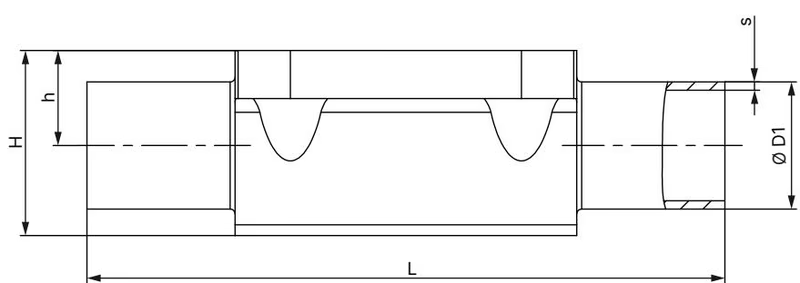
| Diaphragm size | Port connection DN | ∅ D1 | s | L | h | H | Product key |
|---|---|---|---|---|---|---|---|
| DIN EN ISO 1127 / ISO 4200 / DIN 11866 series B | |||||||
| 8 | 8 | 13.5 | 1.6 | 90 | 9.3 | 18.8 | SA40 |
| 15 | 8 | 13.5 | 1.6 | 108 | 8.2 | 19.9 | SA40 |
| 8 | 10 | 17.2 | 1.6 | 90 | 9.3 | 18.8 | SA41 |
| 15 | 10 | 17.2 | 1.6 | 110 | 12.1 | 23.8 | SA41 |
| 15 | 15 | 21.3 | 1.6 | 110 | 12.1 | 23.8 | SA42 |
| 20 | 15 | 21.3 | 1.6 | 119 | 16.0 | 30.3 | SA42 |
| 20 | 20 | 26.9 | 1.6 | 119 | 16.0 | 30.3 | SA43 |
| 25 | 20 | 26.9 | 1.6 | 119 | 19.0 | 37.0 | SA43 |
| 25 | 25 | 33.7 | 2 | 129 | 19.0 | 37.0 | SA44 |
Due to the extensive range of connection variants (Clamp, Threaded, Flange, True Union) across multiple standards (ASME BPE, SMS, BS, JIS) and materials (Cast, Tube, Plastic), please refer to the full manufacturer datasheet for exhaustive dimension tables beyond the primary forged steel welded configuration.
| Diaphragm size | Port connection DN | Actuator size ∅ | Diaphragm material | Kvs value [m3/h] |
|---|---|---|---|---|
| DIN 11850-2 / DIN 11866 series A / DIN EN 10357 series A | ||||
| 8 | 10 | 50 (D) | EPDM | 1.5 |
| 8 | 10 | 50 (D) | PTFE | 1.9 |
| 15 | 15 | 70 (M) | EPDM | 6.5 |
| 15 | 15 | 70 (M) | PTFE | 6.0 |
| 20 | 20 | 70 (M) | EPDM | 12.4 |
| 20 | 20 | 70 (M) | PTFE | 12.0 |
| 25 | 25 | 70 (M), 90 (N) | EPDM | 20.0 |
| 25 | 25 | 70 (M), 90 (N) | PTFE | 17.0 |
| Diaphragm size | Actuator size ∅ | Pilot pressure [bar] | Maximum static operating pressure (EPDM, FKM) [bar] | Maximum static operating pressure (PTFE, GYLON) [bar] |
|---|---|---|---|---|
| 8 | 50 (D) | 3.7...10 | 10 | 10 |
| 15 | 50 (D) | 5.0...10 | 10 | - |
| 15 | 70 (M) | 4.8...10 | 10 | 10 |
| 20 | 70 (M) | 4.8...10 | 10 | 10 |
| 25 | 70 (M) | 4.8...10 | 10 | 6 |
| 25 | 90 (N) | 5.0...10 | 10 | 10 |
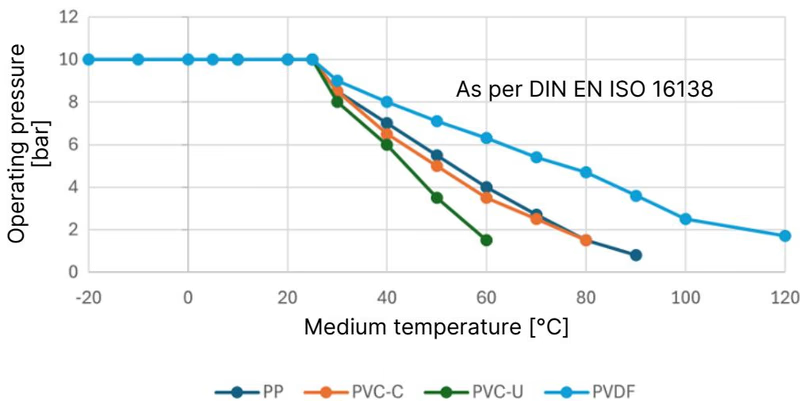
Risk of bursting due to overpressure
If the device bursts, escaping media may cause injuries, burns or scalds. Observe the values indicated on the type label. Valves with reduced spring force require reduced pilot pressure.
The Type 2103 can be combined with various Bürkert control units for decentralised automation:
Ensuring Self-Draining
The installer and the operator are responsible for ensuring self-draining. The inclination angle should correspond to the inclination angle of the pipeline. For pipelines, the inclination angles specified in the valid ASME BPE standard are recommended. The marking for self-draining angles on the port connection serves as a guide and must point upwards.
Explosion Hazard in ATEX Zones
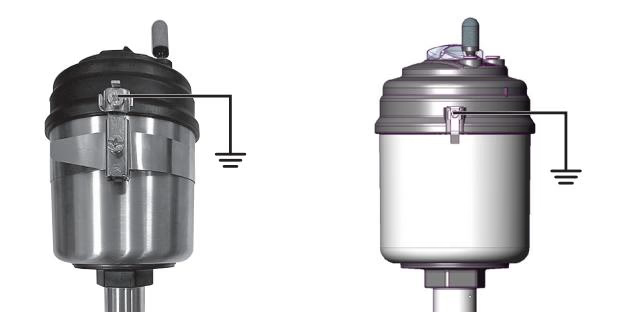
If the device is used in a potentially explosive area (Zones 1/21 and 2/22), appropriate measures must be taken to ensure that static electricity cannot accumulate. The actuator and valve body must be grounded. If a plastic valve body is used, ground the actuator separately. Only use media with a conductivity ≤100 pS/m if there are no flow velocities >1 m/s or if dry running is prevented by special monitoring.
Explore similar products in our catalog