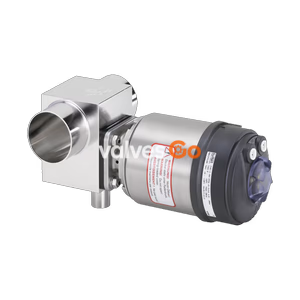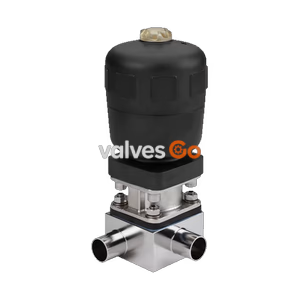
Type 2032

BURKERT 321061 (Type 2103) is a normally closed pneumatic 2/2-way diaphragm valve with DN 20 weld ends, stainless steel body, EPDM seal, 0-10 bar operating pressure, and Kv 10.7 m3/h for hygienic processes.
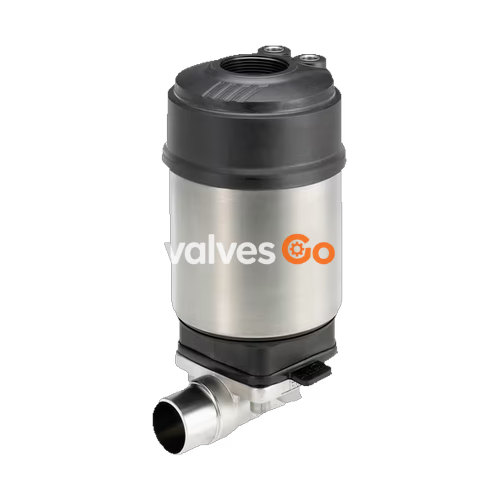
BURKERT 321061 (Type 2103) is an externally controlled 2/2-way diaphragm valve engineered for decentralised process automation in hygienic, sterile, and demanding liquid or gaseous media applications. The valve assembly combines a flow-efficient stainless steel body with a compact ELEMENT design pneumatic piston actuator. Configured in Control Function A, the valve is closed by spring force in its rest position and opens when pilot air pressure is applied. Article 321061 is specified with a nominal diameter of DN 20 and features butt-weld ends conforming to DIN EN ISO 1127, ISO 4200, and DIN 11866 Series B dimensions (outer diameter 26.9 mm, wall thickness 1.6 mm, inner diameter 23.7 mm). Process sealing is provided by a high-temperature EPDM diaphragm capable of handling continuous media temperatures from -10 °C to +143 °C, with steam sterilisation ratings up to +150 °C for durations up to 60 minutes.
The pneumatic piston actuator has an outer diameter of 91 mm (size 70 mm / M) and utilizes a polyphenylene sulphide (PPS) structural core enveloped in a stainless steel 1.4561 (316Ti) cover, providing resistance against harsh cleaning chemicals and atmospheric washdowns. Pilot air pressure between 4.8 bar and 10 bar drives the internal actuator piston via integrated pilot air channels without drawing in ambient air. Article 321061 provides a nominal water flow coefficient (Kv) of 10.7 m³/h and maintains tight bidirectional shut-off up to a maximum operating pressure of 10 bar (PN 16 / Class 150). The valve is certified clean-in-place (CIP) and sterilisation-in-place (SIP) capable and supports full self-draining when mounted at the designated installation angle.
| Parameter | Specification |
|---|---|
| Article Number | 321061 |
| Valve Type | 2103 (ELEMENT series) |
| Valve Construction | Complete assembled valve |
| Circuit Function | 2/2-way, Control Function A (normally closed, spring return) |
| Nominal Diameter | DN 20 (20 mm) |
| Diaphragm Size | 20 |
| Flow Value Kv (Water) | 10.7 m³/h |
| Nominal Pressure Rating | PN 16 (DIN EN 1333) / Class 150 (DIN EN 1759) |
| Medium Operating Pressure | 0.00...10.00 bar |
| Required Pilot Pressure | 4.8...10.0 bar |
| Pilot Air Connection | Push-in connector for 6 mm (1/4 in) outer diameter tube |
| Process Connection Type | Weld end (DIN EN ISO 1127 / ISO 4200 / DIN 11866 Series B) |
| Pipe Connection Dimensions | 26.9 mm outer diameter × 1.6 mm wall thickness (23.7 mm inner diameter) |
| Product Key Connection Code | SA43 |
| Medium Temperature Range | -10...+143 °C |
| Steam Sterilisation Limit | Max. +150 °C for 60 min |
| Ambient Temperature Range | -10...+60 °C (standard push-in connector) |
| Body Material | Stainless steel (1.4435 / 316L) |
| Diaphragm Material | EPDM high-temperature (code AD) |
| Diaphragm Attachment | Bayonet catch |
| Manual Override | None |
| CIP / SIP Capability | Yes |
| Ingress Protection Rating | IP65 / IP67, NEMA Type 4X |
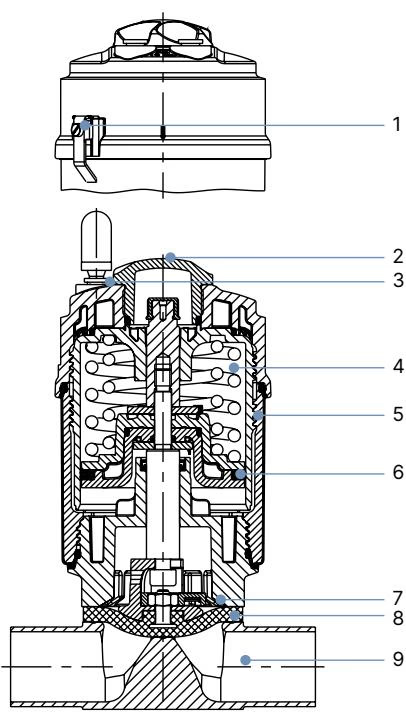
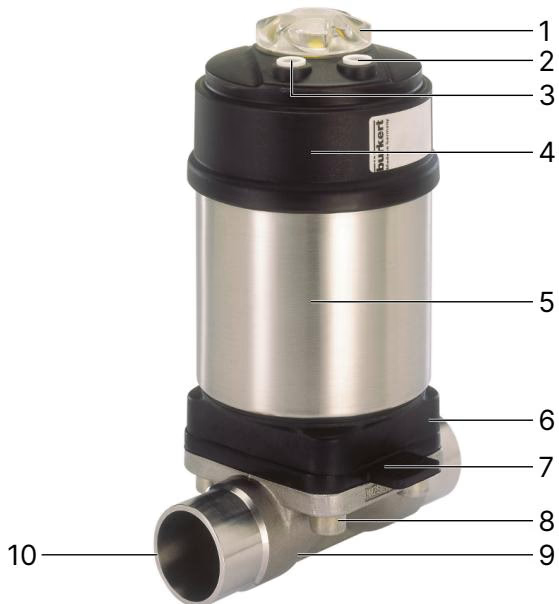
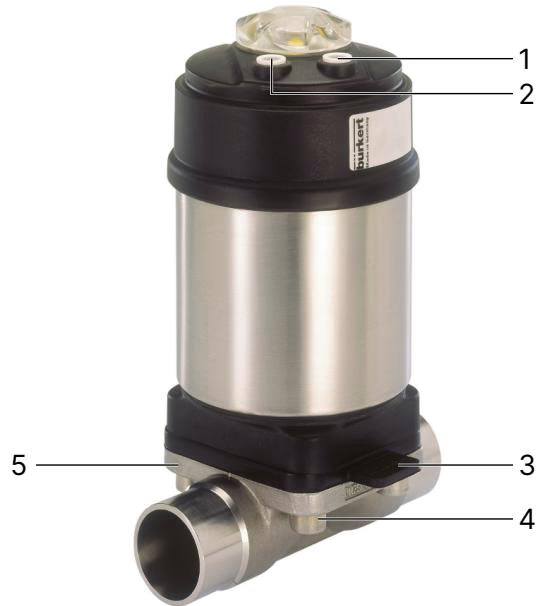
The ELEMENT pneumatic actuator size 70 mm (M) uses an integrated pilot duct design that routes control air without external tubing between automation modules. An optical position indicator is visible through the transparent polysulfone cap at the top of the actuator cover.
| Item No. | Element | Material |
|---|---|---|
| 1 | Ground terminal | Stainless steel 1.4301 / 1.4305 (only on ATEX/IECEx variants) |
| 2 | Transparent cap | Polysulfone (PSU) |
| 3 | Pilot air ports | Push-in connector PP (standard), G 1/8 thread stainless steel 1.4305 |
| 4 | Actuator | Polyphenylene sulphide (PPS) |
| 5 | Cover | Stainless steel 1.4561 (316Ti) |
| 6 | Piston seal | Fluoroelastomer (FKM) |
| 7 | Interface | Polyphenylene sulphide (PPS standard, stainless steel 1.4308 optional) |
| 8 | Diaphragm | EPDM high-temperature (AD) |
| 9 | Valve body | Stainless steel 1.4435 / 316L |
For Control Function A actuators of size 70 mm (M) paired with diaphragm size 20, the closing force is produced by an internal spring pack. The static and dynamic operating pressure limits depend on the supplied pilot pressure:
Medium Temperature Limits for Diaphragm
The EPDM (AD) diaphragm is rated for continuous liquid and gas media exposure between -10 °C and +143 °C. Steam sterilisation is permissible up to +150 °C for a duration of 60 minutes. Diaphragms must not be used as permanent steam shut-off valves.
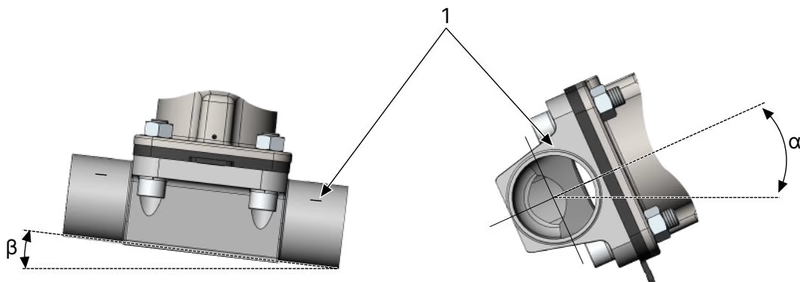
The valve can be mounted in any spatial orientation, though installation with the actuator positioned vertically upright is preferred. For applications requiring complete fluid evacuation, proper line inclination and self-draining body orientation must be verified:
Disassembly Required Before Welding
Thermal conduction during pipeline welding will destroy the EPDM diaphragm and actuator seals. The actuator and diaphragm must be unbolted and removed from the valve body before welding the body into the piping system. Once welding and surface finishing are complete, clean the valve body cavity thoroughly before reassembling the actuator.
For Control Function A, the actuator stem is retracted using compressed air before removing or reinstalling the valve body bolts:
Inspection Intervals
Check the diaphragm for mechanical wear after a maximum of 100,000 switching cycles, or shorten the interval when operating with abrasive media. Retighten the valve body screws crosswise following the initial steam sterilisation cycle.
The 70 mm (M) ELEMENT actuator interface allows integrated mechanical and pneumatic coupling with decentralised Burkert automation modules:
Explore similar products in our catalog