
PN25

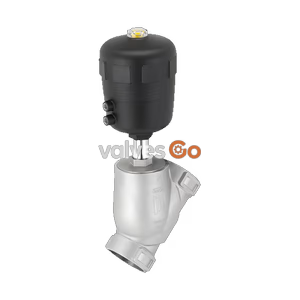
BURKERT 20017346 Type 2100 is a pneumatically operated 2/2-way angle seat valve actuator for DN32 lines. Features NC function A, 0-25 bar operating pressure, PTFE seal, stainless steel body, and ELEMENT automation interface.
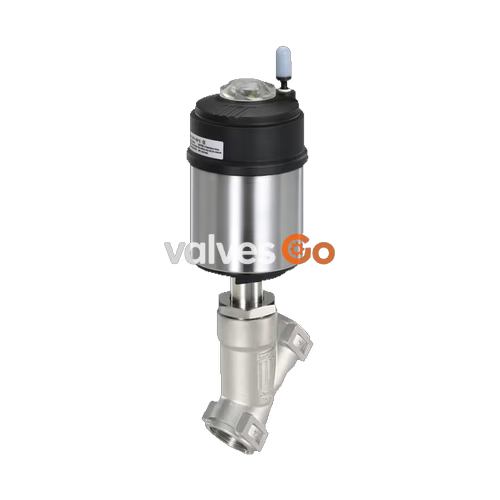
BURKERT 20017346 (Type 2100) is a pneumatically operated 2/2-way angle seat valve actuator unit engineered for decentralized process automation in industrial fluid handling systems. Configured with a nominal diameter of DN32 (seat diameter 32 mm) and control function A (normally closed by spring force), this valve unit handles operating pressures from 0.00 to 25.00 bar(g) and media temperatures from -10 °C to +185 °C. The valve features a flow-below-seat configuration that shuts off against the medium flow to prevent water hammer when handling liquid media, steam, and neutral or aggressive gases. Built with a stainless steel CF3M body, stainless steel 1.4404 trim, PTFE seat seal, and a polyphenylene sulphide (PPS) actuator cover with stainless steel casing, it provides long cycle life backed by a self-adjusting PTFE V-ring stem packing gland with spring compensation.

| Specification Parameter | Technical Value |
|---|---|
| Article Number | 20017346 |
| Valve Type Family | Type 2100 ELEMENT |
| Construction Type | Actuator for 2/2-way angle seat valve |
| Nominal Diameter (Port / Seat) | DN 32 / 32 mm |
| Control Function | Control function A (normally closed by spring force) |
| Operating Pressure Range | 0.00 bar(g) to 25.00 bar(g) |
| Pilot Pressure Range | 5.0 bar(g) to 10.0 bar(g) |
| Medium Temperature Limits | -10.0 °C to +185.0 °C |
| Ambient Temperature Limits | -10.0 °C to +100.0 °C (-10 °C to +60 °C with push-in pilot fitting) |
| Flow Direction | Flow below seat (closes against flow) |
| Seat Seal Material | PTFE (Polytetrafluoroethylene) |
| Valve Body Material | Stainless steel CF3M |
| Actuator Housing | PPS (Polyphenylene sulphide) cover, 1.4561 (316Ti) casing |
| Spindle & Swivel Plate | Stainless steel 1.4401 (316) / 1.4404 (316L) |
| Stem Packing Gland | Filled PTFE V-rings with spring compensation |
| Pilot Air Interface | Push-in connector Ø 6 mm (Interface ELEMENT) |
| Overall Installation Length | 145 mm |
| Cleanability & Hygiene | CIP capable, SIP capable, EC 1935/2004 compliant |
| Ingress Protection Rating | IP65 / IP67, NEMA Type 4X |
BURKERT 20017346 operates using an internal spring assembly that generates closing force directly on the swivel plate, maintaining the valve in a normally closed state when pilot air is unpressurized. Pressurizing pilot port 1 with compressed air at 5.0 to 10.0 bar(g) lifts the actuator piston and spindle, opening the flow path across the 32 mm seat orifice.
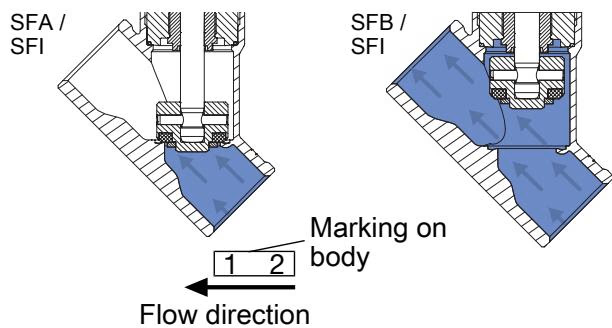
Because the process medium enters below the swivel plate, upstream line pressure assists in opening the valve. This configuration prevents hydraulic pressure shock (water hammer) during closing sequences, making it suitable for liquid media, steam, and process gases.
Flow Direction Safety Limit
Do not use valves configured with flow direction above the seat on liquid media. Flow above the seat with incompressible liquids can generate water hammer, causing pipeline ruptures or equipment failure. BURKERT 20017346 is factory-configured for flow below the seat.
BURKERT 20017346 incorporates the ELEMENT system design, using corrosion-resistant wetted and non-wetted materials certified for process, food, and beverage environments.
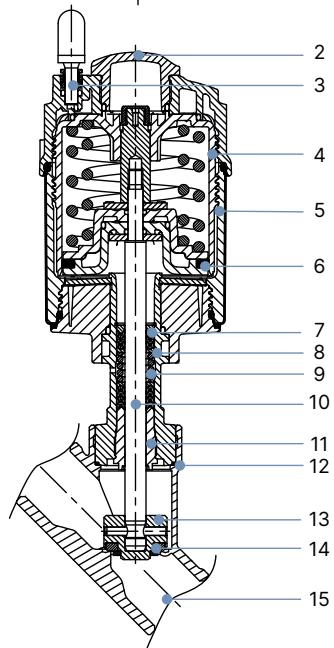
| Item No. | Component Part | Standard Material |
|---|---|---|
| 1 | Ground terminal | Stainless steel 1.4301 / 1.4305 (ATEX variants) |
| 2 | Optical position indicator | Polysulfone (PSU) |
| 3 | Pilot air port | Polypropylene (PP) push-in connector Ø 6 mm |
| 4 | Actuator cover | Polyphenylene sulphide (PPS) |
| 5 | Actuator casing | Stainless steel 1.4561 (316Ti) |
| 6 | Piston seal | FKM |
| 7 | Actuator return spring | Stainless steel 1.4310 |
| 8 | Connecting pipe | Stainless steel 1.4401 (316) / 1.4404 (316L) |
| 9 | Packing gland | Filled PTFE V-rings with spring compensation |
| 10 | Valve spindle | Stainless steel 1.4401 (316) / 1.4404 (316L) |
| 11 | Spindle guide | PEEK |
| 12 | Body seal | Graphite (PTFE optional) |
| 13 | Swivel plate | Stainless steel 1.4401 (316) / 1.4404 (316L) |
| 14 | Seat seal | PTFE (Polytetrafluoroethylene) |
| 15 | Valve body | Stainless steel CF3M (cast 316L equivalent) |
Lubrication Standards
Internal lubricants utilized for the spindle packing gland and actuator piston mechanisms conform to NSF H1 food-grade requirements.
BURKERT 20017346 specifies an overall body installation length of 145 mm, matching standard welded line standards for DN32 pipe geometries (such as DIN EN ISO 1127 / ISO 4200 / DIN 11866 series B). Actuator sizing for DN32 with 0 to 25 bar operating pressure employs the size 90 (N) actuator assembly (outer diameter Ø A = 120 mm).
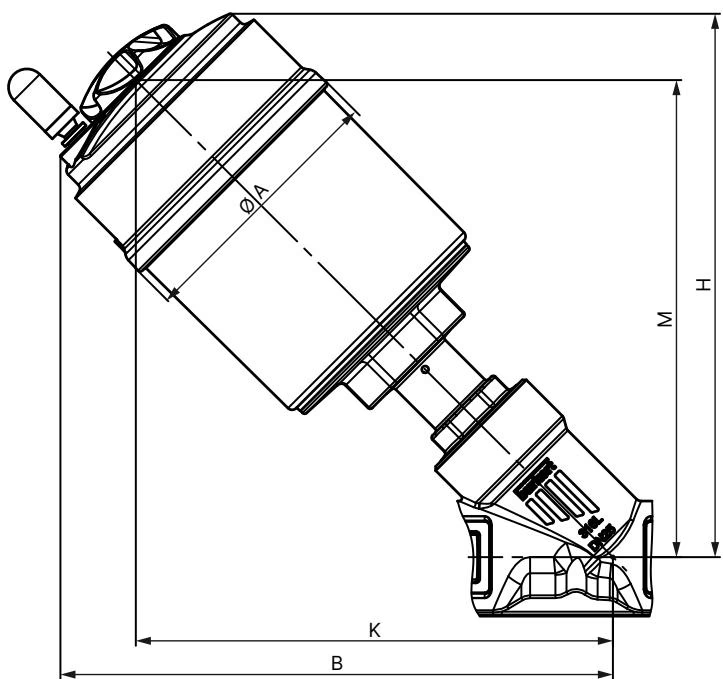
| Connection / Actuator Parameter | Value for DN 32 |
|---|---|
| Seat Orifice Diameter | 32 mm |
| Actuator Size Identification | 90 (N) (or 70 (M) up to 8.5 bar) |
| Actuator Outer Diameter (Ø A) | 120 mm (Size 90) / 91 mm (Size 70) |
| Overall Installation Length (Welded) | 145 mm |
| Actuator Connection Tightening Torque | 65 Nm (+10 / -5 Nm) |
| Pilot Air Tube Connection | Push-in fitting for 6 mm external diameter tubing |
Operating pressure ratings are bounded by the pressure-temperature derating curves of the body alloy according to DIN EN 12516-1 (PN25), ASME B16.34 (Class 150), and JIS B 2220 (10K).
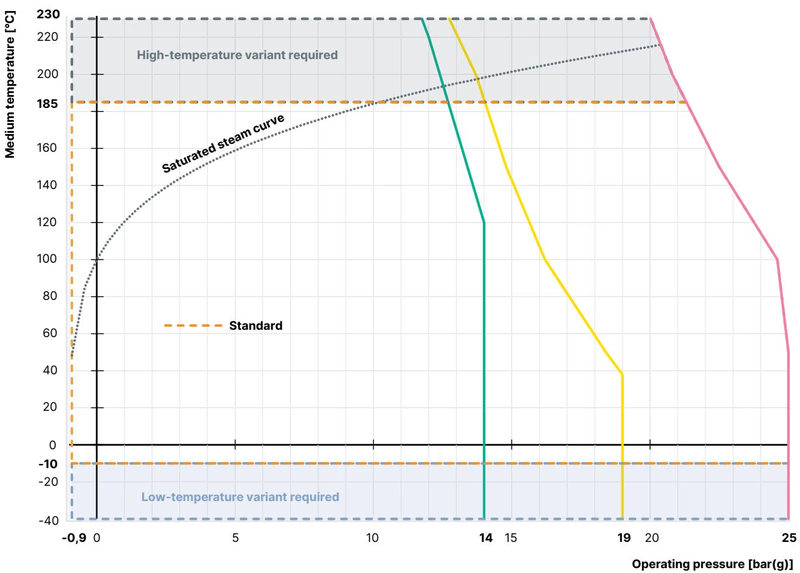
| Medium Temperature (°C) | Maximum Permissible Operating Pressure (bar) |
|---|---|
| -10 to +50 °C | 25.0 bar |
| +100 °C | 24.5 bar |
| +150 °C | 22.4 bar |
| +185 °C | ~20.9 bar |
| +200 °C | 20.3 bar |
When mounting BURKERT 20017346 into the piping network, follow the directional flow arrow cast on the valve body. Pipelines must be cleaned of debris before connection.
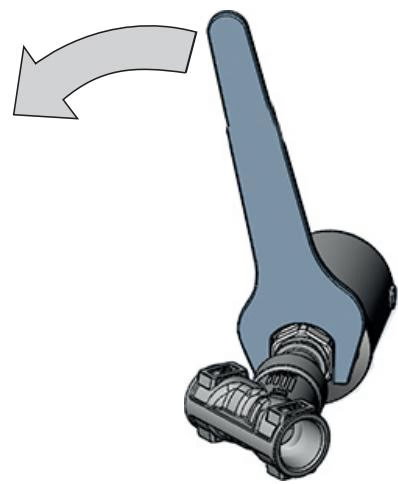
::: caution Actuator Rotation Rules The pneumatic pilot ports can be aligned 360° to accommodate pipe layout constraints. To turn the actuator, pressurize pilot port 1 with 5 bar air to open the valve, hold the body hexagon nut with an open-end wrench, and rotate the actuator nut strictly in the direction shown in the instructional diagram. Turning in the wrong direction may loosen the body connection and compromise pressure containment. :::
BURKERT 20017346 integrates with Bürkert ELEMENT automation modules to form complete decentralized on/off valve systems (Type 8801-YE).
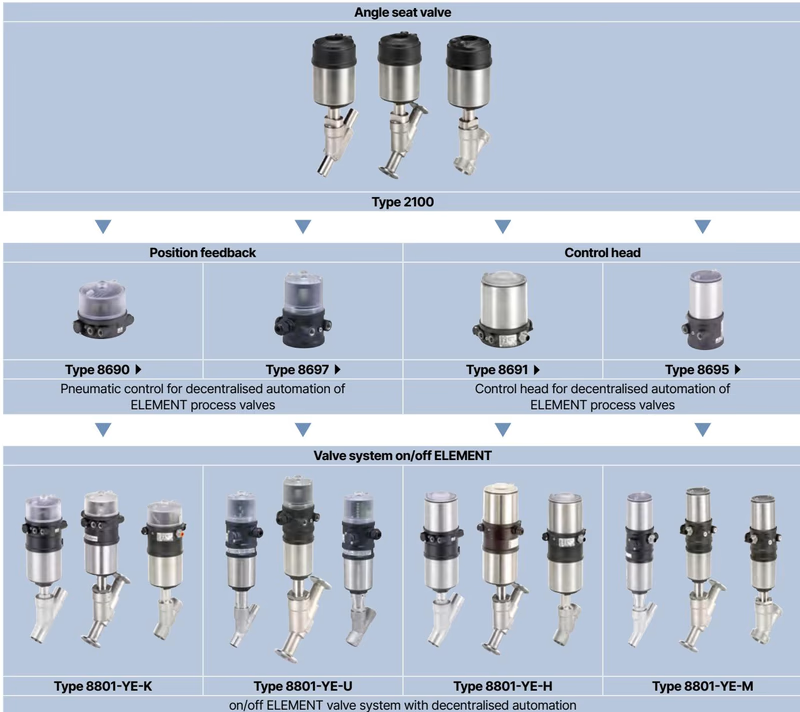
Routine inspection verifies valve performance and sealing integrity under continuous cycling:
| Visual Inspection Area | Observed Condition | Corrective Action |
|---|---|---|
| Process line connection | External fluid leakage at port joints | Tighten piping connections or replace gaskets |
| Relief bore on actuator stem | Fluid escaping through the relief hole | Packing gland worn; replace packing gland kit or actuator |
| Valve seat orifice | Downstream leakage when valve is closed | Clean debris or replace swivel plate and PTFE seat seal |
Explore similar products in our catalog