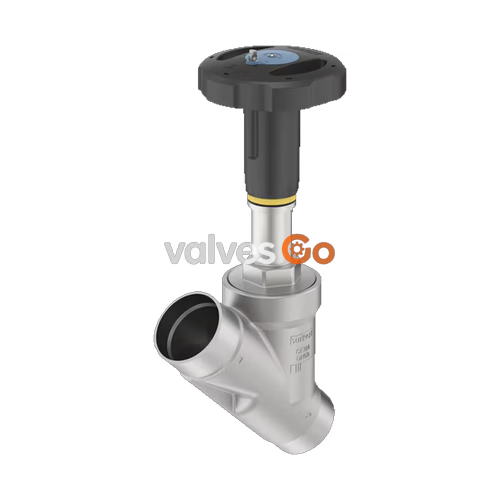
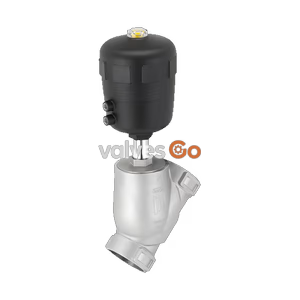
Burkert Type 2960 control valve consists of a manual actuator and an angle seat valve body made of high-quality stainless steel. A parabolic cone enables a flow capacity that is up to 35% higher compared to conventional control valves. The precise spindle guide enables control, even under demanding operating conditions. A soft PTFE or PEEK seal guarantees reliable sealing. The actuator is made of high-quality plastic and is suitable for use in demanding environments. It possesses a visual position indicator and can be optionally equipped with stroke limitation and locking. The packing gland uses tried-and-tested V-seals and possesses spring compensation, which means that it does not need to be pulled back manually.
Product Features
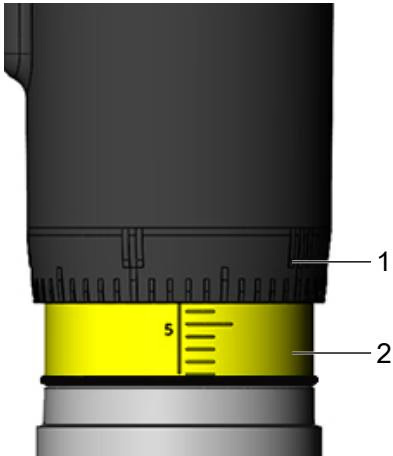
- Position indicator: When turning the handwheel counterclockwise, the reproducible stroke scale becomes visible between the attachment and the handwheel. The scale on the handwheel, together with the stroke scale, enables reproducible adjustment of the flow rate.
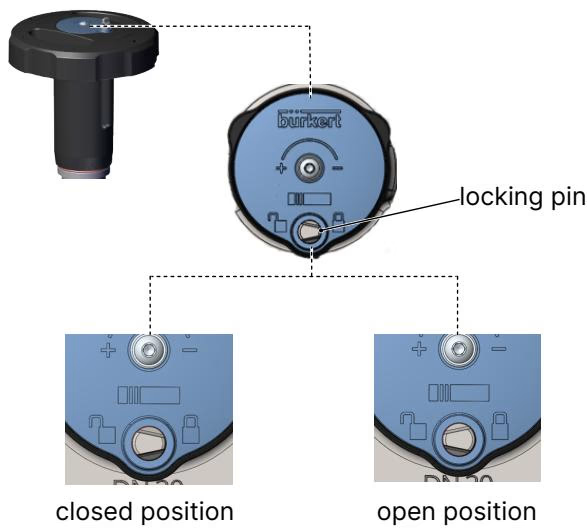
- Interlock (optional): The valve can be secured against unintentional or unauthorized operation. For this purpose, a securing pin can be pressed down and turned. The locking pin has a hole (∅ 3.8) and can be secured with a padlock.
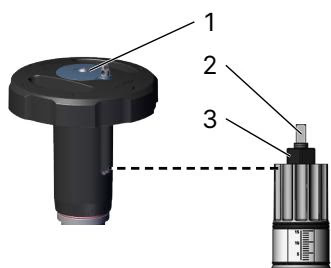
- Stroke limitation (optional): Both the minimum and the maximum position of the valve can be adjusted via an adjustment sleeve. The handwheel can be removed for this purpose.
Materials
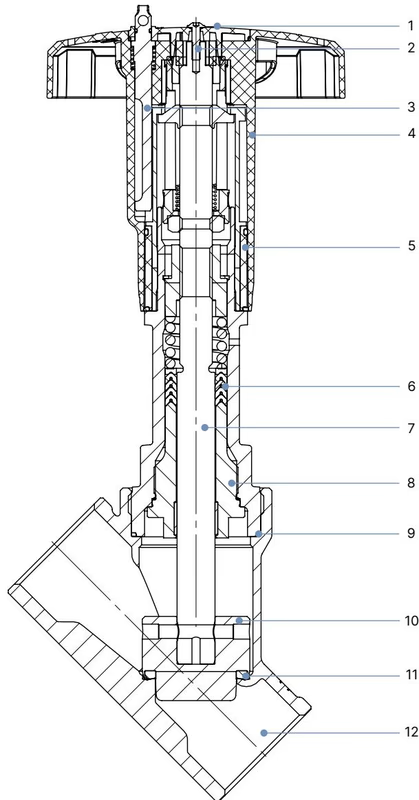
| No. | Element | Material |
|---|
| 1 | Cover | Polyamide (PA) |
| 2 | Screw | Stainless steel 1.4301 |
| 3 | Lock pin | Stainless steel 1.4305 |
| 4 | Handwheel | Polyphenylene sulfide (PPS) |
| 5 | Optical position indicator with scale | Polyamide (PA) |
| 6 | Packing gland | PTFE V-rings (filled), with spring compensation |
| 7 | Spindle | Stainless steel 1.4401 or 1.4404 |
| 8 | Spindle guide | Stainless steel 1.4404 (316L), PTFE filled |
| 9 | Body seal | Graphite |
| 10 | Control cone | 1.4571 (optionally hardened) |
| 11 | Seat seal (optional) | PTFE or PEEK |
| 12 | Valve body | Stainless steel 316L/CF3M |
Fluidic Data
Flow characteristic
- Modified equal percentage flow characteristic.
- Higher flow values compared to globe control valves.
- Theoretical rangeability (Kvs/Kvo) 50:1 for valve seat size 8 to 100.

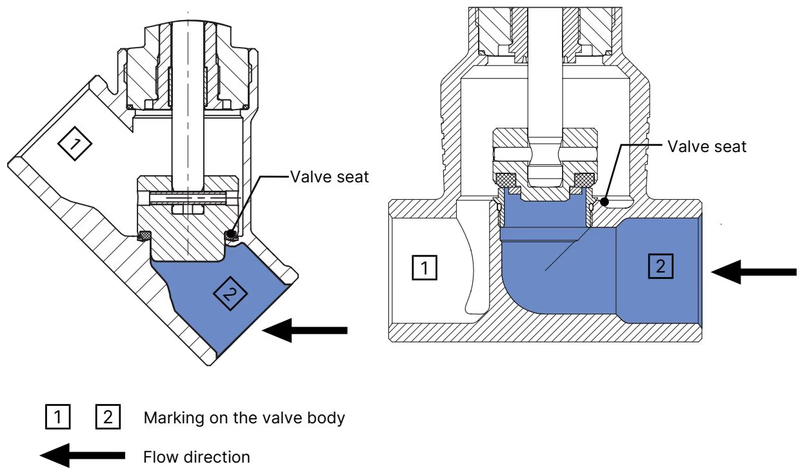
Flow direction The valve seat is always closed against the medium flow. The flow direction should therefore be set such that the valve reaches the flow beneath the valve seat.
Operating Limits
| Tight sealing required | Leakage class (DIN EN 60534 - 4) | Medium temperature | Seat seal |
|---|
| No | III (metallic sealing) | -40 °C...+230 °C | Stainless steel |
| Yes | VI (soft seals) | -40 °C...+130 °C | PTFE |
| Yes | VI (soft seals) | -10 °C...230 °C | PEEK |
Optional Variants
- High-temperature variant: Suitable for applications with steam, neutral gases and other heat transfer mediums up to +230 °C.
- Water variant: For applications with water up to +200 °C, a special configuration of the packing gland increases service life significantly. It is recommended for all water applications.
- Drinking water variant: The materials comply with the assessment principles (UBA) for materials in contact with drinking water up to +85 °C.
- Low-temperature variant: Suitable for minimum medium temperatures down to -40 °C.
- Explosion protection: Optional ATEX / IECEx (Category 2 device suitable for zone 1/21 and zone 2/22). Ex h IIC T4...T2 Gb / Ex h IIIC T135 °C...T300 °C Db.
- Drinking water: Suitable for use in drinking water applications. The materials comply with the assessment principles (UBA) for materials in contact with drinking water (TrinkwasserV).
- Foods and beverages/Hygiene: FDA (Code of Federal Regulations), USP (United States Pharmacopeial Convention), EC Regulation 1935/2004, China food GB Standards.
Safety Instructions
- Risk of injury due to high pressure and escaping medium: Switch off the pressure before working on the device or system. Vent or drain the lines.
- Risk of crushing by mechanically powered parts: Do not reach into the openings of the valve body.
- Explosion hazard due to electrostatic charge (in Ex areas): Take appropriate measures to ensure that no electrostatic charge can build up in the potentially explosive area. Ground the actuator and valve body.