
PN25

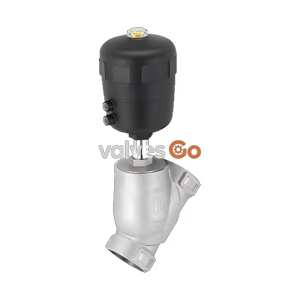
BURKERT 20099713 Type 2101 pneumatically operated 2/2-way globe valve features DN 25 ANSI Class 150 flanges, PTFE seal, normally closed function, flow above seat, and ATEX/IECEx oxygen approval.
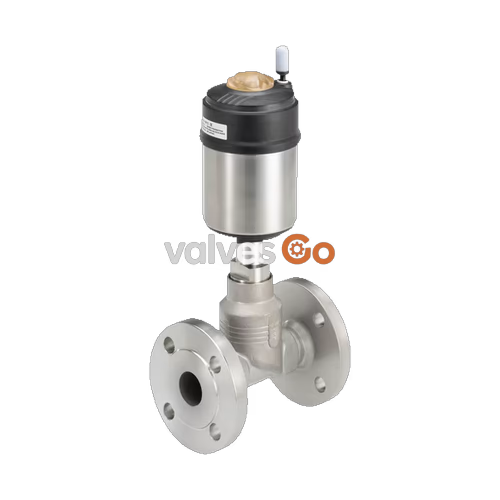
BURKERT 20099713 (Type 2101) is a pneumatically operated 2/2-way globe valve from the ELEMENT series designed for decentralized process automation. Built with an investment cast 316L stainless steel body and 1" ANSI B16.5 Class 150 raised-face flanges, this configuration integrates an actuator size Ø 50 mm (code D) molded from polyphenylene sulphide (PPS). The valve operates with Control Function A (normally closed by internal spring force) and is specifically engineered with flow direction above the seat for shut-off control of gaseous media and steam.
Certified under ATEX and IECEx conformity standards, this specific article is supplied as an oxygen variant cleaned and degreased of all oil and grease according to Burkert specification DIS 1000020797. The stem seal features a self-adjusting PTFE V-ring packing gland with spring compensation, providing maintenance-free spindle sealing and extended operating lifecycles under CIP/SIP conditions.

Type 2101 combines a pneumatic piston actuator with an integrated internal air routing system and a 2-way globe valve body. The piston drives a 1.4401/1.4404 stainless steel spindle coupled to a swivel plate with an embedded PTFE seal ring, which seals against a replaceable screwed-in stainless steel seat.
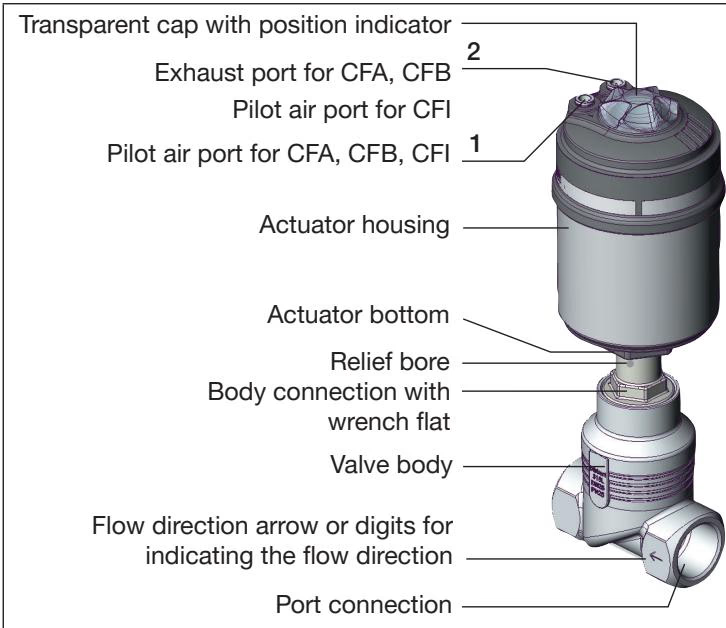
| Item No. | Component | Material |
|---|---|---|
| 1 | Ground terminal | Stainless steel 1.4301 / 1.4305 (ATEX execution) |
| 2 | Optical position indicator | Polysulfone (PSU) |
| 3 | Pilot air ports | Push-in connector PP (standard Ø 6 mm) |
| 4 | Actuator cover | Polyphenylene sulphide (PPS) |
| 5 | Actuator casing | Stainless steel 1.4561 (316Ti) |
| 6 | Piston seal | FKM |
| 7 | Spring assembly | Stainless steel 1.4310 |
| 8 | Spindle tube | Stainless steel 1.4401 (316) / 1.4404 (316L) |
| 9 | Spindle packing | PTFE V-rings (filled), spring-compensated |
| 10 | Spindle | Stainless steel 1.4401 (316) / 1.4404 (316L) |
| 11 | Spindle guide | PEEK (DN 15 to DN 65) |
| 12 | Body seal | Graphite, PTFE (option) |
| 13 | Swivel plate | Stainless steel 1.4401 (316) / 1.4404 (316L) |
| 14 | Seat seal | PTFE |
| 15 | Valve seat with O-ring | Stainless steel 1.4571 with EPDM O-ring |
| 16 | Valve body | Investment cast stainless steel 316L / CF3M |
Burkert article 20099713 utilizes Control Function A with medium entry located above the seat orifice. Medium pressure assists the spring pack in maintaining tight closure across the seat seal.
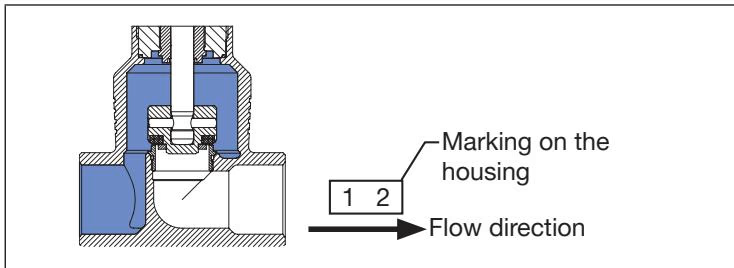
Media Restriction: Gases and Steam Only
Valves with the flow direction above the seat must not be used for liquid media. In liquid service, closing against line momentum induces water hammer capable of rupturing pipelines and causing catastrophic actuator or body damage.
Opening the valve requires pilot air pressure applied to actuator port 1 to overcome both spring pre-tension and process line pressure acting over the surface of the swivel plate.
| Technical Parameter | Value |
|---|---|
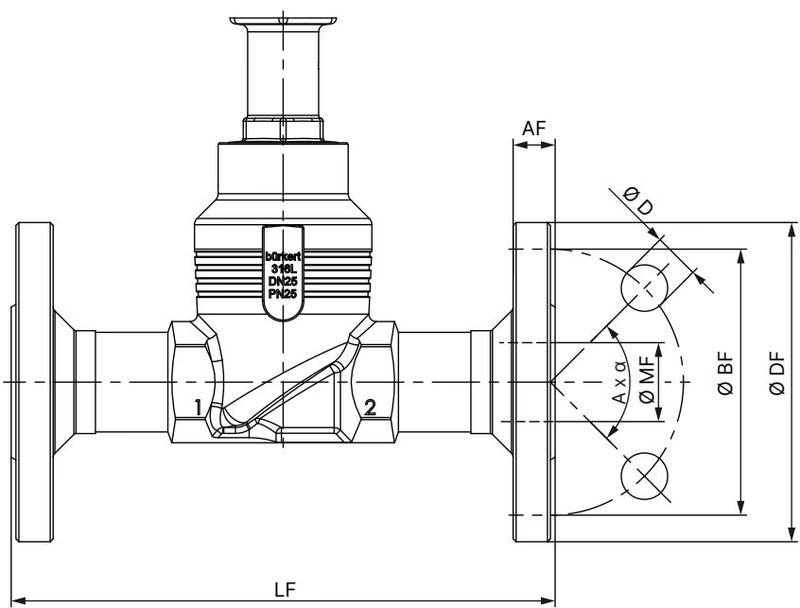
| Nominal Diameter (DN / Seat Size) | DN 25 (25 mm, NPS 1") |
| Port Connection Standard | ANSI B16.5 Class 150 (FTF 37 acc. to DIN EN 558-2) |
| Flow Coefficient (Kv water) | 13 m³/h (measured at +20 °C, 1 bar Δp) |
| Operating Pressure Range | 0 bar(g) to 16 bar(g) |
| Permissible Pilot Air Pressure | 2.7 bar(g) to 10 bar(g) |
| Medium Temperature Limit | 0 °C to +60 °C (oxygen service) |
| Ambient Temperature Limit | -10 °C to +60 °C (push-in fitting limit) |
| Maximum Fluid Viscosity | 600 mm²/s |
| External Seat Leakage | Leakage rate A acc. to DIN EN 12266-1 (air test) |
| Protection Rating | IP65 / IP67 according to IEC 529 / EN 60529 |
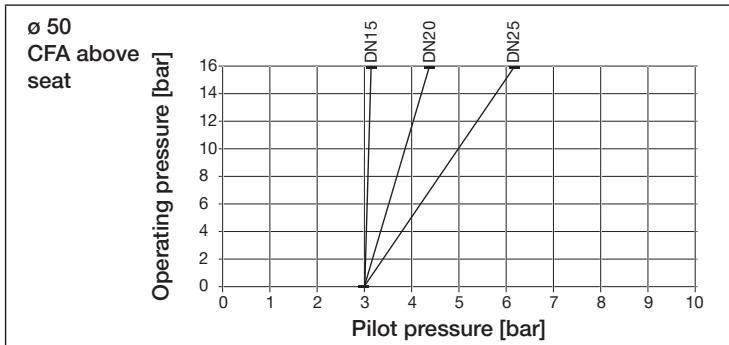
For actuator size Ø 50 mm (D) with flow above the seat on DN 25 ports, the pilot supply pressure must be scaled according to line operating pressure to ensure full stroke opening:
Article 20099713 complies with certification codes EPS 18 ATEX 2 008 X and IECEx EPS 18.0007X (mechanical safety Ex h):
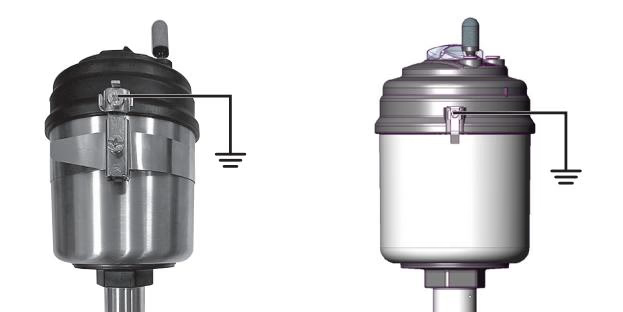
Electrostatic Discharge and Earthing in Explosive Zones
Risk of explosion from electrostatic charge accumulation. Conductive connection between the valve body and pipework must be established. The stainless steel grounding terminal on the actuator must be connected to local plant equipotential bonding. Only wipe housing exteriors with a damp or anti-static cloth. Do not use dry rags.
| Temperature Class | T4 | T3 | T2 |
|---|---|---|---|
| Maximum Permitted Surface Temperature | +135 °C | +200 °C | +300 °C |
| Permissible Ambient Temperature Range | -40 °C to +100 °C | -40 °C to +130 °C | -40 °C to +130 °C |
| Maximum Process Medium Temperature | +125 °C | +185 °C | +285 °C |
Process limits are further bounded by the oxygen execution limit of +60 °C.
360° Actuator Orientation
The pneumatic actuator casing can be freely rotated 360° relative to the body to simplify pilot air line routing. When rotating the actuator, pressurize pilot air port 1 to 5 bar to lift the swivel plate off the seat, preventing mechanical damage to the PTFE sealing lip. Rotate counterclockwise (viewed from below) using an open-end wrench.
| Interface | Size / Spindle | Tightening Torque |
|---|---|---|
| Valve Body to Actuator Connection | DN 25 | 60 ± 3 Nm |
| Screwed-in Valve Seat | DN 25 (tool 652 606) | 40 ± 5 Nm |
| Spindle Guide Bushing | Spindle Ø 10 mm | 6 Nm |
Under normal industrial operating conditions, the actuator requires no servicing. The swivel plate assembly, valve seat, and spindle packing gland are wearing parts that can be overhauled in the field using original Burkert service kits.
160 737216 433262 170652 606683 221Actuator Disassembly Hazard
The PPS actuator housing houses a heavy compression spring under mechanical pre-tension. Do not attempt to open the actuator housing; dismantling the casing will cause explosive ejection of internal springs and serious personal injury.
Explore similar products in our catalog